Rodent control in Shelby County demands structural sealing rather than relying on broadcast poison baits, which often leave target pests to decay inside enclosed wall voids. In historic neighborhoods such as Midtown,…
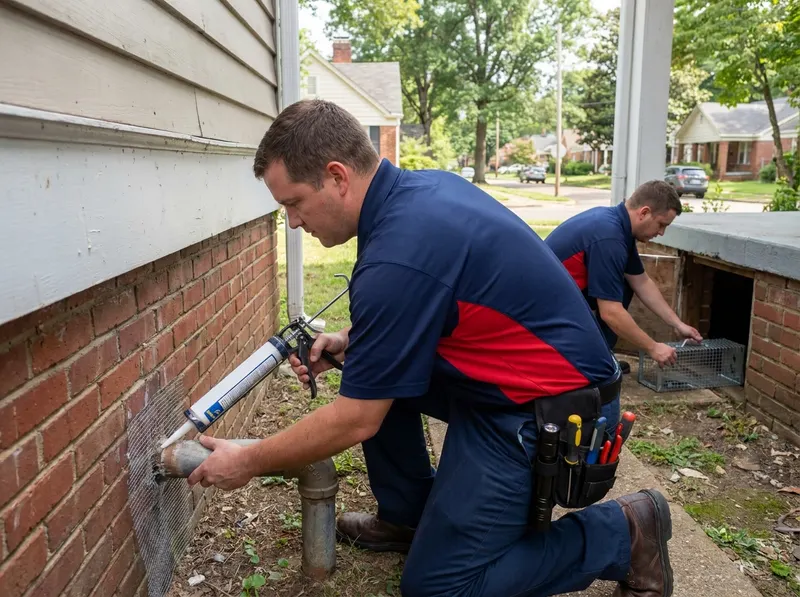
Rodent control in Shelby County demands structural sealing rather than relying on broadcast poison baits, which often leave target pests to decay inside enclosed wall voids. In historic neighborhoods such as Midtown, Cooper-Young, and Central Gardens, aging crawlspace vents, unmortared brick foundations, and settling porch floorboards give rodents direct routes into living areas. Field guidelines from the Centers for Disease Control and Prevention note that a standard house mouse enters gaps as narrow as 6 millimeters, while rats pass through openings spanning 13 millimeters. BlueHearth Insect Removal resolves these breaches using 19-gauge galvanized steel mesh and exterior-grade elastomeric caulking rather than temporary expanding foam, which animals breach within days. A targeted mechanical barrier preserves indoor environmental quality for children and pets while physically denying access to suburban utility conduits near High Point Terrace and Binghampton.
Eradication protocols follow strict non-toxic capture methodologies to protect home air quality and household companions. Mechanical snap traps and tamper-resistant retention stations are mapped along baseline travel routes, structural sills, and attic runs where runs show oily sebum rub marks. Applying guidance from the Environmental Protection Agency on risk-mitigation measures, interior control emphasizes mechanical trapping over loose anticoagulant pellets. This operational model avoids secondary poisoning risks to domestic dogs and outdoor wildlife. Properties bordering canopy-dense riverfronts, Overton Park, or urban green spaces like Shelby Farms Park frequently face roof rat pressures traveling along rooflines. Technicians treat attic access panels and plumbing chases under guidelines issued by the Department of Housing and Urban Development to keep nesting materials from entering primary living envelopes.
Subsequent phases remediate attic and crawlspace insulation damaged by urine crystallization and pheromone trails. Contaminated materials are extracted under strict protective standards aligned with Occupational Safety and Health Administration respiratory requirements to neutralize airborne pathogens. Technicians mist affected wood framing and joists with non-volatile biocides approved under the Tennessee Department of Agriculture regulatory framework, breaking down pheromone scent marks that draw outside rodents to Berclair, Frayser, or Raleigh crawlspaces. The National Institute of Pest Health Management confirms that failure to eliminate pheromones increases the likelihood of re-colonization along rooflines by over 60 percent. For homes in Whitehaven, crawlspace vapor barriers receive heavy-gauge repairs and ground seal verification in compliance with Department of Energy moisture management standards.
Homeowners choose between localized exclusion and complete envelope remediation depending on the age and construction of the foundation. Pier-and-beam foundations require ground-to-sill barrier curtains, whereas monolithic slab foundations in East Memphis require focus on garage threshold seals, weeping holes, and exterior AC chase penetrations documented by the Building Owners and Managers Association. By prioritizing structural exclusion, homes maintain long-term protection without ongoing pesticide applications. All structural work conforms to residential air quality codes set by the Building Performance Association and residential safety measures outlined by the International Association of Certified Home Inspectors.
Every job gets a firm, written price after a free on-site visit.
Tell us about your rodent exclusion & eradication job in Memphis and we'll send a clear, written quote, usually the same day.
 BlueHearth Insect Removal